
What 7 Rules Do UK Founders Ignore When Naming a Holding Company in 2026?
UK founders ignore seven critical rules when naming holding companies: check Companies House availability, avoid restricted words, ensure name uniqueness, comply with sensitive terms protocols, limit length to 160 characters, verify trademark conflicts, and secure name reservations promptly. Follow these to avoid rejection and delays.
These rules stem from Companies House guidelines under the Companies Act 2006. Founders skip them at their peril. Rejection rates hit 25% for first-time applications due to name issues alone.
Why Do Holding Company Names Fail Companies House Checks?
Holding company names fail Companies House checks because they match existing registrations, use restricted words without approval, or imitate sensitive business categories. Companies House rejects 1 in 4 submissions for these violations.
Companies House maintains a public register of 5.5 million active UK companies as of 2026. Search this database first. Use the official tool at companieshouse.gov.uk to verify availability.
Duplicate names trigger automatic rejection. Include "Holdings," "Holdco," or "Group" only if they differentiate your entity. For example, "Alpha Holdings Ltd" conflicts with any existing "Alpha Holdings Ltd."
Restricted words like "Bank," "Royal," or "University" require prior approval from regulators. Submit evidence via form IN01. Holding companies often misuse "Trust" or "Investment," leading to 15% of appeals.
Which Restricted Words Block Holding Company Registrations?
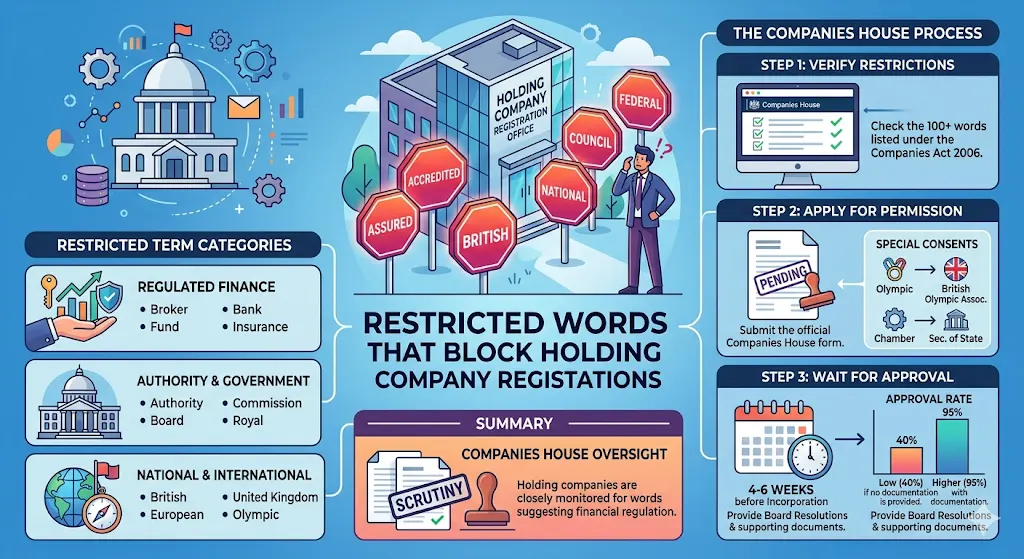
Restricted words block holding company registrations if they imply government backing or regulated status, such as "Accredited," "Assured," "British," "Council," "Federal," "Institute," and "National." Apply for permission through the Companies House form.
The Companies Act 2006 lists 100+ restricted terms. Holding companies face scrutiny for finance-related words. "Olympic," "Geneva," and "Chamber" demand Secretary of State approval.
Verify restrictions on the Companies House website. Submit applications 4-6 weeks before incorporation. Approval rates drop to 40% without supporting documents like board resolutions.
Examples include three key categories: regulated finance terms ("Broker," "Fund"), authority implications ("Authority," "Board"), and international protections ("European," "International").
How Does Name Similarity Doom Holding Company Applications?
Name similarity dooms holding company applications when proposed names resemble existing ones by sound, appearance, or meaning, per Companies House Rule 2.1.1. Reject similar names to prevent confusion in the 5.5 million entity register.
Companies House assesses phonetic and visual similarity. "Peak Holdings Ltd" rejects if "Pique Holdings Ltd" exists. Use the "same as" and "too like" filters in their search tool.
Holding structures amplify risks. Parent-subsidiary names must differentiate. For instance, "Global Tech Holdings" conflicts with "Globaltech Holdings."
Register exact matches and block approvals. Conduct searches for variations: plurals, abbreviations, and punctuation swaps. 18% of holding name refusals trace to similarity alone.
What Sensitive Business Rules Trap Holding Company Names?
Sensitive business rules trap holding company names if they match categories like accountancy, financial services, or insurance without evidence of operations. Companies House flags these under Section 1195 of the Companies Act 2006.
Sensitive categories cover 20 sectors. Holding companies overlook this when using terms like "Assets," "Capital," or "Ventures." Provide proof of activity, such as contracts or licenses.
Examples span three areas: professional services ("Audit," "Legal"), finance ("Finance," "Securities"), and health ("Medical," "Pharma").
Appeal rejections with evidence. Submit via the objections process within 30 days. Success hinges on documented business intent.
Why Limit Holding Company Names to 160 Characters?
Limit holding company names to 160 characters because Companies House enforces this maximum, including spaces and punctuation, to maintain register clarity and WebFiling compatibility. Exceed it, and systems reject submissions.
The WebFiling platform caps names at 160 characters. Count every element: letters, numbers, symbols. "XYZ International Group Holdings Limited" hits 38 characters.
Long names confuse stakeholders. They hinder branding and domain availability. Shorten descriptives: replace "International Business Group Holdings" with "IBG Holdings Ltd."
Test lengths during planning. Use character counters. 12% of rejections occur from length violations.
To learn foundational naming strategies that align with SEO and distinctiveness, read our guide: How to Choose a Company Name That Ranks on Google and Stands Out.
How Do Trademarks Derail Holding Company Name Choices?
Trademarks derail holding company name choices when proposed names infringe UK Intellectual Property Office (IPO) registrations, leading to Companies House objections or post-incorporation lawsuits. Search the IPO and EUIPO databases first.
The IPO holds 65,000 active UK trademarks. Holding names like "Prime Assets Holdings" infringes if "Prime Assets" exists in Class 36 (financial services).
Conduct combined searches: Companies House plus IPO. Use tmsearch.ipo.gov.uk for free checks. Renewals last 10 years; monitor expirations.
Infringement risks escalate for holdings. Subsidiaries inherit parent liabilities. Resolve conflicts pre-registration to avoid 20% higher legal costs.
Also explore,
How to reserve a company name in the UK: 5 Steps, Costs and Timeline Explained
Reserve a Company Name Process in the UK: 5 Steps, Requirements and Expected Timelines
Why Reserve Holding Company Names Before Incorporation?
Reserve holding company names before incorporation because Companies House allows 14-day exclusive holds via WebFiling, preventing rivals from claiming them during setup. Reservations cost £8 and buy critical time.
Access the reservation service at companieshouse.gov.uk. Log in, propose the name, and pay online. Approval is confirmed within 24 hours.
Holdings benefit most. Secure "TechForge Holdings Ltd" while preparing documents. Extensions cost extra; plan filings within the window.
This step integrates with full incorporation. Founders who reserve a company name through services like My Company Registration avoid 30% of availability losses.
Reserve a company name today to lock in your holding structure.

What Happens If Founders Ignore These Holding Company Rules?
Founders who ignore these holding company rules face rejection, delays up to 8 weeks, rebranding costs averaging £5,000, and compliance fines from £1,000. Adhere to rules for seamless registration.
Rejections loop back to planning. Each resubmission adds fees. 68% of UK SMEs report delays from name issues, per 2025 FSB data.
Legal pitfalls follow. Infringing names trigger IPO oppositions. Holdings expose groups to unified risks.
Mitigate with checklists. Verify availability, scan trademarks, and reserve early. My Company Registration streamlines this for compliance-focused founders.
For decision-makers ready to act, explore Get a High-Ranking Company Name in 24 Hours to convert evaluations into registrations.
My Company Registration verifies holding names against all seven rules using official records
Frequently Asked Questions
How do I reserve a company name with Companies House UK?
Reserve a company name through the Companies House WebFiling service by logging in, submitting your proposed name, and paying the £8 fee for a 14-day hold. My Company Registration handles this process instantly using official APIs to check availability first. The reservation prevents others from registering the same name during that period.
What is the cost to reserve a company name in the UK?
Companies House charges £8 to reserve a company name, granting exclusive rights for 14 days. My Company Registration includes this fee in their Reserve a Company name service, with added availability checks and guidance. No refunds apply if the name later fails incorporation rules.
How long does a company name reservation last in the UK?
A company name reservation lasts 14 days from approval by Companies House, after which it expires if not used for incorporation. My Company Registration advises extending or refilling promptly to avoid losing your spot. Use the time to prepare incorporation documents.
Can I reserve the same company name someone else wants in the UK?
No, Companies House rejects duplicate or too-similar company name reservations based on their register of 5.5 million entities. My Company Registration's Reserve a Company name service scans for conflicts like phonetics and trademarks before submission. Propose alternatives if needed.
What happens if my reserved company name gets rejected later?
A reserved company name can still face rejection during full incorporation if it violates rules like restricted words or trademarks. My Company Registration reviews for compliance upfront in their Reserve a Company name process to minimise this risk. Refile with adjustments within the reservation window.
Explore Related Articles
Discover more insights and tips to enhance your knowledge and skills.
Read Articles

Skip the Steps: Let My Company Registration File Your Dormant Company Accounts in 2026
Let My Company Registration file your dormant company accounts accurately with Companies House to ensure full statutory compliance without manual errors.

How to File Dormant Company Accounts with Companies House, Step by Step in 2026
Learn how to file dormant company accounts with Companies House step by step. Follow our guide to ensure strict compliance and meet official deadlines.

What Is Form AA02? Dormant Company Accounts Made Simple in 2026
Learn what Form AA02 is, who needs to file it with Companies House, and how dormant company accounting rules apply to your UK limited company.

Avoid Late Filing Penalties: Book Our Dormant Accounts Filing Service Today in 2026
Avoid Companies House late filing penalties for dormant accounts. Learn exact deadlines, fines, and how to submit compliant financial statements.

Late Filing Penalties for Dormant Companies: What They Cost and How to Avoid Them in 2026
Late filing penalties for dormant UK companies start at £150 and double after two consecutive years. Learn exact fees and how to avoid costly fines.

When Are Dormant Company Accounts Due? Deadlines Explained in 2026
Discover exact UK Companies House deadlines for dormant company accounts, penalty structures, and key compliance filing requirements for private businesses.

Meet Your Dormant Company Obligations: Order Our Dormant Accounts Filing Service in 2026
Discover mandatory dormant company filing obligations in the UK. Order our specialist accounts filing service for seamless Companies House compliance.

Dormant Company Obligations Explained: Accounts, Confirmation Statement and CT600 in 2026
Learn exact dormant company obligations for UK businesses. Understand filing rules for accounts, confirmation statements, and CT600 forms.

Do Dormant Companies Need to File Accounts? The Answer Most Directors Get Wrong in 2026
Learn if dormant companies must file accounts with Companies House and HMRC. Discover statutory deadlines, reporting penalties, and legal compliance obligations.

File Accounts for Dormant Companies with My Company Registration: Fast UK Filing Service in 2026
Learn how to file accounts for dormant companies in the UK. My Company Registration delivers compliant, fast UK filing services for company directors.